ServiceNow, Software Asset Management
Foundation for AI: redesigning the flagship
Software Asset Management was a great business with happy customers, but every redesign had fixed a local pain and added inconsistency downstream. I made the case for a strategic reset, led a three-week design sprint, and designed the vision myself.
- Role
- Design strategist and hands-on designer for the vision
- Pod
- 3 PMs, 3 designers, 1 researcher, 1 architect, 1 content writer
- Timeline
- About 4.5 months of design cycles, 2024
- Outcome
- $750M → $1B+, +25% NetSat, −21% support tickets
The problem
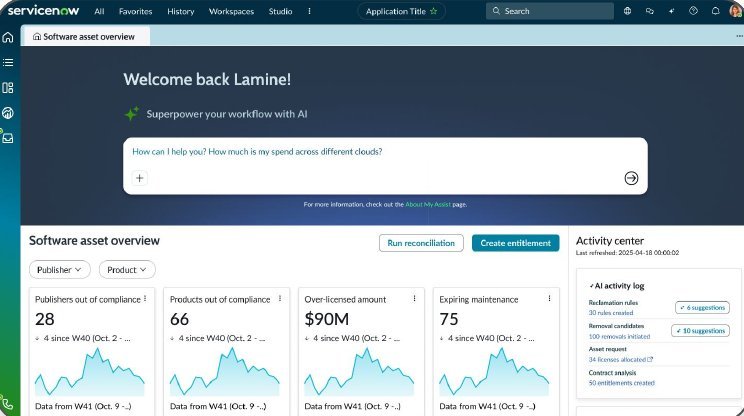
Growth had been execution-led, not strategy-led. Under the surface we had fragmented UX, heavy onboarding and complex flows. Those came from a legacy stack, siloed teams and reactive design, and underneath that, no shared north star.
By 2024 the effects showed: a drop in revenue, low adoption and a rising number of support tickets. The team was moving fast, but in different directions, and conflicting stakeholder goals were causing design churn.
Every redesign fixed a local pain, but created downstream inconsistency over years.
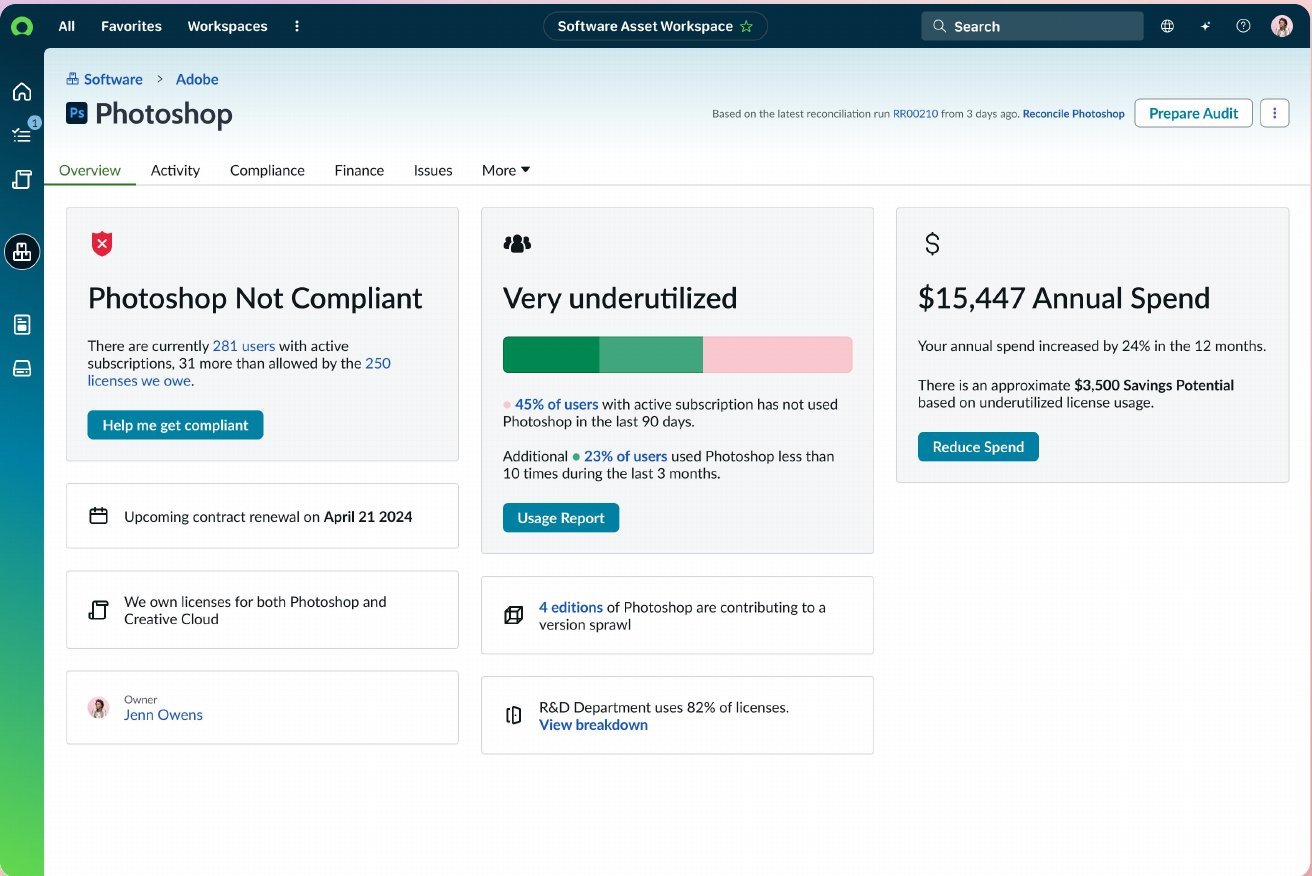
What the research showed. The complexity lived in the data models: every vendor, from Adobe to Oracle to Zoom, has its own license types, terms and renewal cycles.
How I led
I framed the problem with data and walked our GM, product leader and engineering leader through the risks of staying on course. That earned us borrowed cycles. I formed a working group, doubled the design and PM staffing for the effort, and got research prioritized. Research made it clear the UX couldn’t be fixed without re-architecting the backend.
Then I negotiated vision cycles with executives, in exchange for a promise: a north star vision that would guide the next four releases.
What I made
The vision prototypes, the playbook model and the clickable demo-day concepts. During the sprint I was the player-coach, designing alongside the team every day.
How I led people
A heads-down, three-week sprint with daily critiques and lightning demos. Working-group designers owned their decisions, and I held them accountable for them.
Three horizons
We set three goals: easy workflows for users, growth and AI adoption for the business, and a scalable, trustable, intuitive design. Instead of pitching a single solution on demo day, we brought leadership three options, each with its tradeoff written down.
Conservative: a local fix
Stabilizes the business, but doesn’t win new market share.
Progressive: modular, lego design
Moderate engineering spikes, clear ROI in the next releases, and a foundation for future scale.
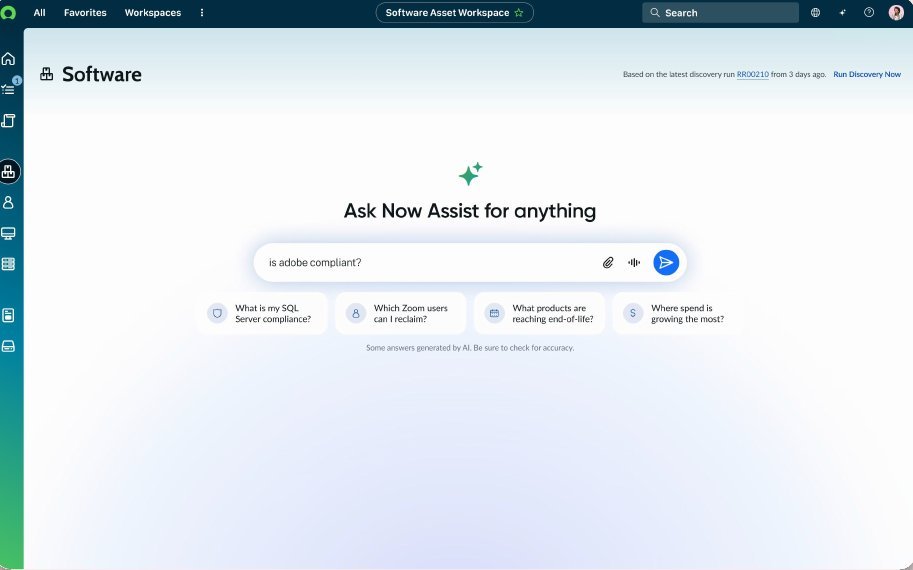
Vision: AI-first
Significant platform re-architecture. It serves as the 2–3 year roadmap.
The playbook model
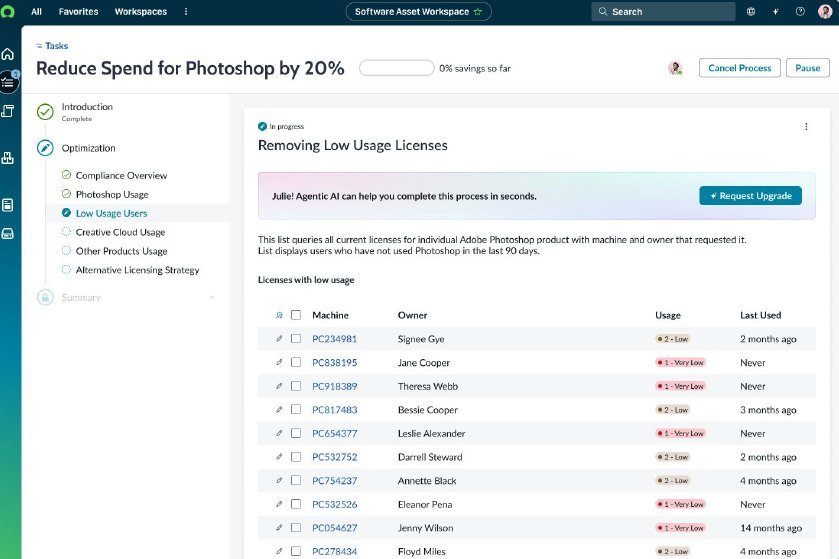
The smallest unit is a step: a small, reusable function that solves one thing, like finding inactive users. A goal is a meaningful outcome made of steps. A playbook combines goals, and it scales up or down with the software and the situation.
For Jenn, a software asset manager trying to cut spend, “Minimize spend” becomes five guided steps. Because each step is a contained unit of work, an AI agent can run it, and a person can take over at any point.
Shipping it
My game plan was the archer’s draw: pause, step back, then make the strategic leap. An executive investment review aligned the GM, product, engineering and design on goals and success metrics, and we reset the roadmap.
Execution brought its own pressure: scope management, decision delays and questions about engineering feasibility. So we shipped SaaS first for the fastest impact and rolled out by capability. We used engineering spikes to prove the north star was buildable, and created shared T-shirt sizing so design and engineering agreed on scope and timelines.
Outcome
The redesign earned four global innovation awards, and ServiceNow was named a Leader in the 2025 Forrester Wave for Software Asset Management Solutions.
- Modular playbooks: a scalable platform with lower cognitive load.
- Guided, standard flows: faster time to value and fewer support tickets.
- Consistent UX patterns: higher velocity and faster alignment across teams.
- AI-ready architecture: a foundation for trust and expansion as AI agents arrived.
- $750M → $1B+business unit revenue
- +25%NetSat
- −21%support tickets, within two releases